Protocolo Operacional Padrao: The Ultimate Guide to Process Excellence
In the modern corporate landscape, the pursuit of efficiency is no longer just a competitive advantage; it is a prerequisite for survival. Imagine an orchestra where every musician decides to play at a different tempo; the result would be auditory chaos. In the business world, this “unified rhythm” is established by a protocolo operacional padrao.
This article explores how this fundamental tool transforms operational disorder into predictable success, ensuring that the quality of your product or service remains constant, regardless of who is performing the task or what time of day it is.
What Exactly is a Standard Procedure?
Many managers confuse complex training manuals with the strategic simplicity of a well-designed procedure. At its core, it is a document that describes, step-by-step, the activities necessary to complete a recurring task.
The primary goal is standardization. When a team has clear direction, the risk of human error drops drastically, and the learning curve for new employees is reduced from weeks to days. It serves as the “source of truth” for how things ought to be done within an organization.
The Pillars of an Effective Document
For a protocolo operacional padrão to be useful, it cannot be a static document forgotten in a digital drawer. It needs to be a “living” resource that reflects the reality of the workshop floor or the office desk. The fundamental pillars include:
- Clarity and Objectivity: Use action verbs and short sentences. Avoid corporate jargon that muddies the waters.
- Accessibility: The document must be available where the work actually happens—whether that’s a tablet on an assembly line or a pinned file in a Slack channel.
- Responsibility: It must be clear who executes the task and who supervises the quality control.
- Measurability: How do we know the process was successful? Define the expected output clearly.
Why Your Business Needs Standardization Now
The absence of defined processes creates what experts call “tribal knowledge”—knowledge that resides only in the heads of a few veteran employees. If that person leaves the company, the process effectively dies with them.
Implementing a management system based on a protocolo operacional padrao offers tangible benefits that directly impact the bottom line:
- Waste Reduction: Fewer mistakes mean less rework and a significant saving on raw materials or billable hours.
- Workplace Safety: In industrial or healthcare sectors, following the correct steps prevents fatal accidents and ensures compliance with labor laws.
- Scalability: You can only replicate a business model (like a franchise) if you have processes that can function independently of the founder’s presence.
- Continuous Improvement: You cannot improve what you cannot measure. Once a process is standardized, you can identify bottlenecks and optimize them.
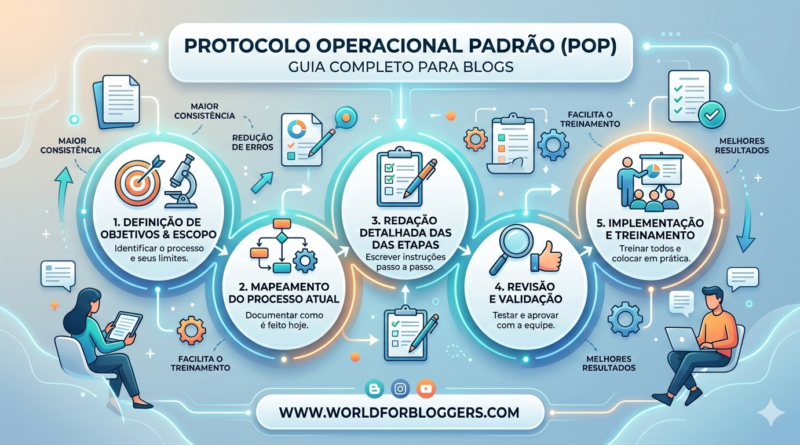
How to Structure Your Document (Step-by-Step)
There is no one-size-fits-all template, but the structure below is widely accepted by quality auditors (such as ISO 9001) and excellence managers:
1. Header and Identification
Include the name of the task, the document code, the creation date, and the current version. Version control is crucial to ensure no one is following obsolete instructions.
2. Objective
Answer the question: “Why does this process exist?” For example: “To ensure customer service via chat is completed in under 5 minutes with a 90% satisfaction rate.”
3. Materials and Tools
List everything needed before starting. If it’s an IT process, list the software and access permissions; if it’s production, list the PPE (Personal Protective Equipment) and raw materials.
4. Description of Stages
This is the heart of the protocolo operacional padrao. Use numbered lists.
- Example: 1. Turn on the machine; 2. Check the oil level; 3. Enter the batch code.
5. Contingencies (The “What If” Section)
What should the employee do if the software crashes or a part is missing? Providing a “Plan B” prevents the entire operation from grinding to a halt while waiting for a manager’s intervention.
Overcoming the “Bureaucracy” Myth
A common resistance to implementing a protocolo operacional padrao is the idea that it stifles creativity or creates unnecessary bureaucracy. However, the opposite is true.
When the routine, repetitive tasks are automated or standardized, the human mind is freed to focus on innovation and complex problem-solving. McDonald’s doesn’t standardize its burger flipping because it wants to prevent creativity; it does so so that the manager can spend time thinking about local marketing or customer experience rather than worrying if the pickles are in the right place.
Implementation: The Human Factor
Writing the document is only 30% of the work. The remaining 70% is getting people to use it. To ensure adoption:
- Involve the Doers: Don’t write the procedure from a high-level executive office. Ask the people who perform the task daily to help draft the steps. They know the shortcuts and the pitfalls better than anyone.
- Training: Don’t just email a PDF. Walk the team through the process, demonstrate the steps, and let them practice under supervision.
- Feedback Loops: Create a culture where employees feel comfortable suggesting updates to a protocolo operacional padrao. If a step is no longer working, it should be changed, not ignored.
Digital Transformation and Process Management
In the digital age, the “paper binder” is dead. Modern companies use Business Process Management (BPM) software to host their procedures. These tools allow for:
- Interactive Checklists: Employees check off steps as they go.
- Video Integration: Sometimes a 30-second video clip is more effective than three pages of text.
- Real-time Updates: When you update a process, it is instantly updated for everyone in the organization globally.
A digital protocolo operacional padrao can also be linked to analytics, showing managers exactly how long each step takes and where the team is struggling. This data-driven approach turns quality management into a science rather than a guessing game.
Conclusion
Precision is the byproduct of discipline. By defining a protocolo operacional padrao, your company stops relying on luck and starts relying on a system. It protects your brand’s reputation, keeps your employees safe, and provides a solid foundation for growth.
Whether you are a small startup looking to organize your first hires or a large corporation aiming to cut costs, the path to excellence always begins with a clear, written, and followed process.
Read also our recently blog: Delta flight dl275 diverted lax: Navigating the Unexpected on Long-Haul Routes