
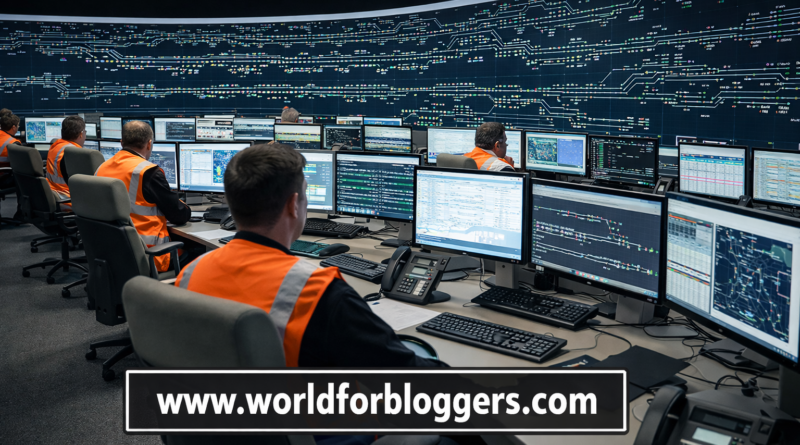
Rail Operating Centre: The Digital Heart of Modern Infrastructure
The golden age of steam may be long gone, but the railway industry is currently in the midst of a second “Great Revolution.” This time, however, the transformation isn’t happening on the tracks with heavier engines or faster pistons; it is happening behind the glass and silicon of the Rail Operating Centre.
As global populations migrate toward urban hubs, the pressure on existing rail networks has reached a fever pitch. To meet this demand, the industry has shifted away from decentralized, manual signal boxes toward centralized hubs of technological excellence. These facilities represent the pinnacle of logistical engineering, serving as the “brain” for thousands of miles of track.
What Exactly is a Rail Operating Centre?
At its core, a Rail Operating Centre is a centralized facility where signallers, controllers, and engineers monitor and manage train movements across a specific geographic region. In the past, controlling a railway meant having small signal cabins every few miles. Today, a single ROC can manage an entire national corridor.
These centers are more than just offices; they are high-security, mission-critical environments designed for 24/7 resilience. By consolidating expertise under one roof, rail authorities can respond to incidents faster, optimize energy consumption, and ensure that “on-time” isn’t just a goal, but a guarantee.
The Architecture of Efficiency
The transition to a centralized model wasn’t just about saving space; it was about data integration. A modern facility typically houses several key departments:
- Signalling Control: Utilizing digital interfaces to set routes and maintain safe distances between trains.
- Electrical Control: Managing the overhead line equipment (OLE) and power distribution to ensure the fleet stays moving.
- Incident Management: A rapid-response team that coordinates with emergency services and on-the-ground technicians during disruptions.
- Passenger Information: The team responsible for the real-time updates you see on your smartphone apps and station platforms.
Technological Integration: ETCS and Beyond
One of the primary drivers behind the construction of a new Rail Operating Centre is the implementation of the European Train Control System (ETCS). Traditional signaling relies on trackside “lights” (colored aspects) that drivers see through their windscreens.
In a digital railway, the “signal” is sent directly to a computer screen inside the driver’s cab via a secure radio network. This allows trains to run closer together safely, effectively increasing the “bandwidth” of the tracks without laying a single new rail. This level of precision is only possible when managed by the sophisticated software suites found within a centralized hub.
The Human Element in a Digital World
Despite the heavy reliance on automation and AI-driven scheduling, the human element remains the most critical component of the Rail Operating Centre. The role of the signaller has evolved from a physical job—pulling heavy levers—to a highly analytical one.
Controllers today act as “network pilots.” They use predictive modeling to see how a five-minute delay in one suburb might ripple across the country three hours later. This foresight allows them to make “conflict detections” early, rerouting freight or adjusting platform assignments before the passenger even realizes there is a problem.
Training and Simulation
Because the stakes are so high, these centers often house state-of-the-art simulators. New recruits spend hundreds of hours in virtual environments that mimic the exact layout of the geography they will manage. They practice for “black swan” events—total power failures, extreme weather, or equipment breakdowns—ensuring that when they step onto the live floor, they are ready for anything.
Why Centralization Matters for the Passenger
You might wonder why a commuter should care about a building located hundreds of miles away. The benefits of a Rail Operating Centre translate directly to the daily commute:
- Improved Reliability: With all decision-makers in one room, the “telephone game” of relaying information is eliminated. Decisions are made in seconds, not minutes.
- Real-Time Data: Because the ROC is the single source of truth for train locations, the data on your arrival app is significantly more accurate.
- Safety: Automated interlocking systems managed by the ROC make it mathematically impossible to clear two trains onto the same piece of track.
- Environmental Impact: Optimized driving profiles managed by the center reduce the “stop-start” nature of train travel, saving massive amounts of electricity.
Challenges of Centralization
It would be remiss not to mention the risks associated with putting “all your eggs in one basket.” A Rail Operating Centre is a high-value target for cyber threats. As railways become more connected, the “air gap” between the railway’s internal systems and the public internet must be fiercely guarded.
Furthermore, there is the challenge of “mental workload.” In a centralized hub, a single signaller might be responsible for a much larger area than their predecessors. Ergonomic design, lighting that mimics natural circadian rhythms, and “dark-cockpit” software design (where screens only light up when there is a problem) are used to prevent operator fatigue.
The Future: AI and Predictive Maintenance
Looking ahead, the Rail Operating Centre is set to become even more proactive. We are entering the era of “Predictive Maintenance.” Sensors on the tracks and on the trains themselves send a constant stream of “health data” back to the center.
Instead of waiting for a point motor to break and cause a delay, the ROC’s AI will flag that a specific motor is drawing more current than usual. An engineer can then be dispatched to fix it overnight before a failure ever occurs. This shift from “fail and fix” to “predict and prevent” is the ultimate goal of the modern railway.
A Global Standard
From the London North Eastern Railway’s hubs to the high-speed corridors in Japan and China, the ROC model is the global standard. It represents a shift in philosophy: the railway is no longer a collection of tracks and trains, but a singular, integrated machine.
The next time you glide through a junction at 100 mph, or see your train arrive exactly when the screen promised it would, remember the Rail Operating Centre. It is the silent conductor of the modern world, orchestrating the complex dance of steel and data that keeps our civilization moving.
Key Statistics of Modern Rail Control
| Feature | Traditional Signal Box | Modern Operating Centre |
| Control Radius | 5–15 Miles | 100–500+ Miles |
| Communication | Analog Phone/Paper | Digital Radio/Fiber Optic |
| Safety System | Manual Interlocking | Computer-Based Interlocking (CBI) |
| Staffing | Isolated Operators | Collaborative Multi-Disciplinary Teams |
Conclusion
The evolution of the Rail Operating Centre is a testament to human ingenuity. By marrying 19th-century infrastructure with 21st-century technology, we have created a transport system that is safer, faster, and more sustainable than ever before. As we look toward a future of autonomous trains and hyper-connected cities, these centers will remain the essential nodes that tie our world together.
Read also our recently blog: Silverback Gorilla