
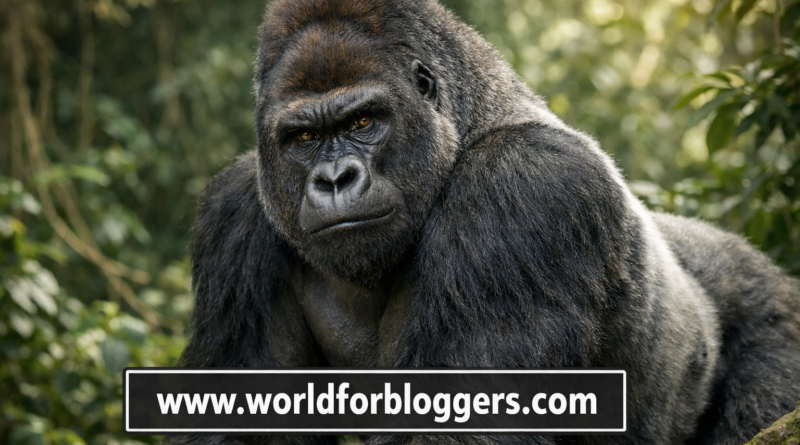
Silverback Gorilla: The Majestic Guardians of the African Rainforest
The mist-covered mountains of Central Africa hold many secrets, but none are as awe-inspiring as the sight of a massive primate emerging from the dense foliage. Often misunderstood as monsters of myth, these creatures are actually the peaceful, highly intelligent architects of their ecosystem. Among them, the leader stands out—a figure of immense power and quiet dignity.
The Anatomy of Power
When we speak of the silverback gorilla, we are describing a mature male that has reached a specific stage of biological development. Contrary to popular belief, they are not a separate species. Instead, the term refers to the saddle-shaped patch of silver hair that develops on a male’s back as he reaches sexual maturity, typically around 12 to 15 years of age.
Physical Characteristics
An adult male is a marvel of natural engineering. Standing at a height of roughly 5.5 to 6 feet when upright, they can weigh anywhere from 300 to 450 pounds. Their arm span is even more impressive, often reaching over 7 feet, allowing them to navigate the rugged terrain and dense undergrowth of their volcanic or lowland homes with surprising agility.
Their strength is legendary. It is estimated that a fully grown male possesses the physical power of roughly eight to ten Olympic-class human weightlifters. This strength is rarely used for unprovoked aggression; rather, it serves as a deterrent to rivals and predators, ensuring the safety of the family unit.
Social Structure: The Troop Dynamics
The social life of these primates is complex and deeply rooted in a patriarchal system. A typical troop consists of one dominant male, several adult females, and their various offspring. Occasionally, subordinate younger males (known as blackbacks) may remain with the group, but the ultimate authority rests with the silverback.
The Role of the Leader
The leader is more than just a figurehead; he is the decision-maker. He determines:
- Movement: When and where the group travels to find food.
- Rest: When the troop stops to build nests for the evening.
- Conflict Resolution: He mediates disputes between females or rambunctious youngsters.
- Protection: He will put his life on the line to defend his family from leopards or intruding males.
Despite their intimidating size, these leaders are often remarkably gentle. They are frequently seen playing with toddlers or patiently allowing infants to climb over their massive frames. This duality—ferocious protector and tender father—is a hallmark of their sophisticated emotional intelligence.
Habitat and Diet: The Gentle Herbivore
These primates are found primarily in the tropical forests of Equatorial Africa. Depending on the specific subspecies—Mountain, Western Lowland, or Grauer’s—their habitats range from sea-level swamps to high-altitude volcanic slopes reaching 13,000 feet.
Foraging Habits
Despite their muscular build, the silverback gorilla is almost entirely herbivorous. Their diet consists of:
- Shoots and Stems: Bamboo is a favorite in certain regions.
- Fruit: Critical for lowland populations.
- Bark and Roots: Providing essential minerals and fiber.
- Insects: Occasionally, they will consume ants or termites for a protein boost.
They spend about half of their waking hours eating. Because their diet is relatively low in calories compared to their body mass, they must consume large quantities of vegetation—sometimes up to 60 pounds a day—to maintain their energy levels.
Communication and Intelligence
Communication within the troop is a rich tapestry of vocalizations, gestures, and facial expressions. Researchers have identified at least 25 distinct vocal sounds used to convey everything from contentment during feeding to warnings of approaching danger.
Behavioral Cues
The “chest-beat” is perhaps the most famous display. Contrary to the Hollywood depiction of pure rage, chest-beating is often a way to release pent-up energy, signal location to other groups, or assert dominance without resorting to physical violence. It is a highly effective form of communication that prevents unnecessary injuries within the species.
Their intelligence is equally striking. In captivity and the wild, they have demonstrated the ability to use tools—such as using a stick to test the depth of a pool of water before crossing. They also exhibit deep emotional bonds, mourning their dead and showing signs of empathy toward distressed troop members.
The Threat of Extinction
The survival of the silverback gorilla is currently balanced on a knife’s edge. All subspecies are classified as either Endangered or Critically Endangered by the IUCN. The challenges they face are multifaceted and largely driven by human activity.
Major Threats
- Habitat Loss: As human populations expand, forests are cleared for agriculture, mining, and timber. This fragments their territory, making it harder for groups to find food and mates.
- Poaching: While rarely targeted for meat today, they often fall victim to snares set for other animals. Additionally, the illegal pet trade remains a peripheral threat.
- Disease: Because they share approximately 98% of their DNA with humans, they are highly susceptible to human respiratory illnesses and viruses like Ebola, which can devastate entire populations.
- Climate Change: Rising temperatures affect the availability of their food sources and the stability of their high-altitude habitats.
Conservation: A Path Forward
The story is not all doom and gloom. Conservation efforts over the last few decades have shown that dedicated intervention works. The Mountain Gorilla population, for instance, has seen a steady increase, recently surpassing 1,000 individuals thanks to intensive “extreme conservation” measures.
Eco-Tourism
Regulated tourism has become a double-edged sword but remains a vital tool for survival. The revenue generated from trekking permits provides local communities with an economic incentive to protect the forests rather than exploit them. This “gorilla economy” funds anti-poaching patrols and veterinary teams that monitor the health of the troops.
Community Engagement
Successful conservation relies on the people living adjacent to the parks. By building schools, improving healthcare, and providing sustainable farming alternatives, organizations ensure that the local population sees the silverback gorilla as an asset to be cherished rather than a competitor for land.
The Importance of the Apex Primate
Why does the survival of this single animal matter? They are known as “umbrella species.” By protecting the vast tracts of forest they require to survive, we inherently protect thousands of other species of plants, birds, and insects that share their home. They are the gardeners of the forest, dispersing seeds through their dung and creating clearings that allow sunlight to reach the forest floor, promoting new growth.
The presence of the silverback gorilla is a barometer for the health of our planet’s “green lungs.” Their disappearance would signify a catastrophic failure of the ecosystem that would eventually ripple out to affect human populations as well.
A Final Reflection
Watching a silverback gorilla in the wild is a humbling experience. It is a reminder of our own origins and the thin line that separates the “civilized” world from the raw, unbridled beauty of nature. These giants ask for very little—only the space to exist, to raise their families, and to wander the emerald corridors of their ancestral homes.
As we move further into the 21st century, the responsibility lies with us. Through conscious travel, support for conservation NGOs, and a global commitment to reducing our carbon footprint, we can ensure that the silver-furred kings of the forest continue to rule their misty domains for generations to come. The silverback gorilla is not just a relic of the wild; it is a living testament to the strength and fragility of life on Earth.
Read also our recently blog: Why I’m Building CapabiliSense