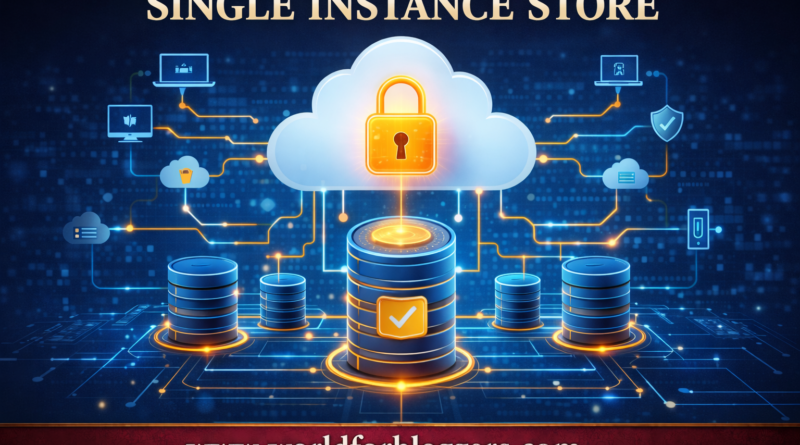
Single Instance Store: The Architect of Efficient Data Management
In the early days of computing, storage was a luxury. Engineers fought for every kilobyte, writing tight code and compressing files to fit within the rigid boundaries of physical hardware. Fast forward to the modern era, and while we talk in petabytes and exabytes, the fundamental challenge remains the same: efficiency. As data grows exponentially, simply buying more hard drives is no longer a sustainable strategy.
Enter the concept of the single instance store (SIS). This architectural approach to data management is the unsung hero of enterprise backups, email servers, and cloud environments. By ensuring that only one unique copy of a piece of content is maintained on storage media, SIS transforms how organizations handle the massive influx of digital information.
What Exactly is a Single Instance Store?
At its core, a single instance store is a system’s ability to identify duplicate data and replace those duplicates with pointers to a single, authoritative copy. Imagine an office where 50 employees receive the same 10MB PDF attachment in an email. In a traditional system, that server would bloat by 500MB. With SIS enabled, the server saves the file once (10MB) and creates 49 tiny “shortcuts” or references for the other recipients.
This isn’t just about saving a few megabytes; it’s about systemic optimization. Whether it’s at the file level or the block level, the goal is to minimize “write” operations and maximize the utility of existing capacity.
The Evolution of Deduplication Technology
To understand where SIS fits today, we have to look at its evolution. In the Windows Storage Server era, SIS was a specific feature used to manage volumes. Today, the term is often used interchangeably with “data deduplication,” though they differ slightly in execution.
- File-Level SIS: Operates by comparing entire files. If two files are identical, one is kept.
- Block-Level SIS: A more granular approach. It breaks files into smaller chunks (blocks). If a 1GB video file has 100MB of footage identical to another file, only the unique segments are written.
Modern cloud providers and backup software have refined these techniques, making the single instance store model a standard requirement for any high-performance data center.
Key Benefits of Implementing SIS
Why do CTOs and system administrators obsess over this technology? The benefits extend far beyond just “clearing up space.”
1. Dramatic Cost Reduction
The most immediate impact is financial. By reducing the physical footprint of data, companies can delay expensive hardware refreshes. Less physical disk space also means less power consumption and lower cooling costs in the data center—a win for both the budget and the environment.
2. Enhanced Backup and Recovery
Backups are the bane of an IT department’s existence when data is redundant. By utilizing a single instance store, backup windows are slashed. Since less data is being moved across the network and written to the backup target, the entire process becomes leaner and more reliable.
3. Optimized Bandwidth
In distributed environments where data is synced across offices or to the cloud, SIS prevents the “clogging” of network pipes. Sending one copy of a file instead of twenty ensures that critical business applications have the bandwidth they need to function.
How the Magic Happens: The Technical Process
You might wonder how a system knows two files are the same without spending all its CPU power scanning every bit. The secret lies in hashing.
When a file enters a single instance store, the system runs it through a mathematical algorithm (like SHA-256) to create a unique digital fingerprint, or “hash.”
- The system checks its index to see if that hash already exists.
- If the hash is new, the data is stored.
- If the hash is already present, the system simply updates the file system metadata to point to the existing data.
This process happens lightning-fast, often behind the scenes, without the end-user ever realizing their “file” is actually just a pointer to a shared resource.
Common Use Cases
Where do we see this technology in the wild? It’s more common than you think.
| Industry/Tech | Application of SIS |
| Email Systems | Storing one copy of a company-wide announcement attachment. |
| Virtualization | Running 100 Virtual Machines (VMs) that all share the same OS core files. |
| Cloud Storage | Services like Dropbox or Google Drive use versions of this to manage global scale. |
| Software Distribution | Pushing updates to thousands of workstations simultaneously. |
Challenges and Considerations
No technology is a magic bullet. While a single instance store offers massive upside, there are trade-offs to consider:
- Processor Overhead: Calculating hashes and managing the index requires CPU and RAM. On underpowered systems, this can lead to performance degradation.
- Data Integrity: If the “single instance” of a file becomes corrupted, every user pointing to that file loses access. This necessitates robust RAID configurations and frequent integrity checks.
- Fragmentation: Over time, as files are deleted and added, the physical layout of data on the disk can become fragmented, potentially slowing down read speeds.
The Future: AI and Intelligent Storage
As we look toward the future, the single instance store concept is merging with artificial intelligence. Future systems won’t just look for exact binary matches; they will use “fuzzy logic” to identify near-identical data or patterns that compressed even further.
We are moving toward a “content-aware” storage model where the system understands what it is holding, allowing for even smarter deduplication across disparate platforms and encrypted volumes.
Conclusion
The single instance store remains a cornerstone of digital efficiency. By shifting the focus from “how much can we hold” to “how well can we hold it,” SIS allows businesses to scale their digital operations without being crushed by the weight of their own data. In an era where information is the new oil, SIS is the refinery that ensures not a single drop wasted.
Whether you are a small business owner looking to optimize your local server or an enterprise architect designing a global cloud footprint, understanding and leveraging the power of single-instance logic is essential for a streamlined, cost-effective future.
Read also our recently blog: Tokenizasyon