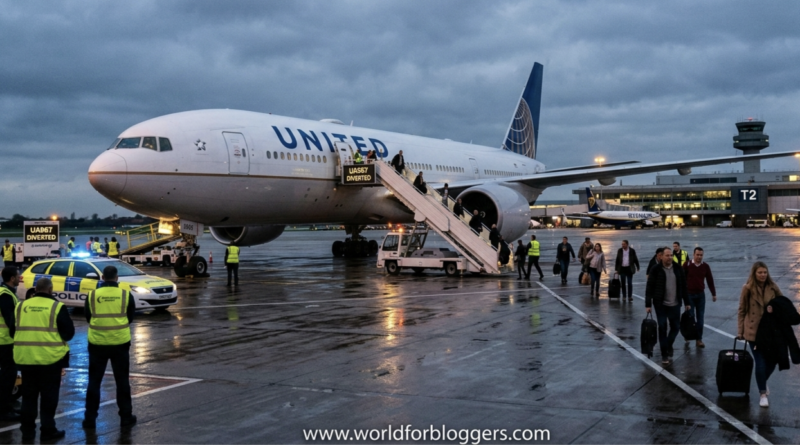
United flight ua967 diverted: A detailed look at the mid-air event
The world of international aviation is a marvel of engineering and strict protocol, designed to ensure that millions of passengers reach their destinations safely every day. However, even with the most advanced technology and highly trained crews, the unpredictable nature of the skies sometimes leads to a change in plans. One such instance that recently captured the attention of the travel community involved a significant detour, where united flight ua967 diverted from its original trans-Atlantic path to an unscheduled stop in Canada.
This incident, occurring on the popular route from Naples, Italy, to Newark, New Jersey, serves as a fascinating case study in aviation safety, pilot decision-making, and the logistical gymnastics required to handle hundreds of displaced passengers in a remote location. In this article, we will break down the timeline, the cause of the diversion, and what passengers can expect when their journey takes an unexpected turn.
The flight profile: From Naples to Newark
United Airlines Flight 967 is a regularly scheduled long-haul service connecting the historic Italian city of Naples (NAP) with Newark Liberty International Airport (EWR). Typically operated by a Boeing 767-300ER, this flight covers approximately 4,400 miles over the Atlantic Ocean, a journey that usually takes just over ten hours.
On the day of the incident, the aircraft departed Naples after an initial delay, climbing to its cruising altitude to begin the long trek across the pond. For the first several hours, the flight proceeded normally, with passengers enjoying the standard in-flight amenities as the jet moved toward the coast of North America.
Why united flight ua967 diverted
The situation changed as the aircraft moved east-southeast of Newfoundland, Canada. While cruising at high altitude, the flight crew received an alert from the Engine-Indicating and Crew-Alerting System (EICAS). Specifically, the alert pointed toward a potential issue with the Forward Equipment Exhaust Fan.
In many cases, a single mechanical alert doesn’t necessitate an immediate landing, but this specific fault was accompanied by a concerning symptom: a burning odor in the cockpit. In the world of aviation, smoke or a burning smell is treated with the highest level of urgency.
The pilots followed standard operating procedures immediately:
- Checklist Execution: The crew ran through the “Cabin Air Quality” and “Smoke/Fumes” checklists.
- Communication: They contacted United’s maintenance control via satellite link to troubleshoot the issue.
- Emergency Declaration: To ensure priority handling by Air Traffic Control (ATC), the pilots declared a formal emergency.
Because they were over the Atlantic with several hours of flight remaining before reaching Newark, the decision was made that united flight ua967 diverted to the nearest suitable airport. In this region of the North Atlantic, that often means St. John’s International Airport (YYT) in Newfoundland.
The landing at St. John’s
St. John’s International Airport is a frequent “safe haven” for trans-Atlantic flights experiencing technical or medical issues. Its long runways and experienced emergency services make it an ideal spot for a Boeing 767 to land under weight.
The aircraft touched down safely on Runway 28 at St. John’s around 8:25 PM local time. Emergency vehicles were on standby, a standard precaution for any aircraft landing after declaring an emergency due to smoke or fumes. Fortunately, the landing was uneventful, and the aircraft taxied to a gate where passengers were able to deplane.
The passenger experience: Stranded in Newfoundland
When a wide-body aircraft like the one used for united flight ua967 diverted makes an unscheduled stop in a city like St. John’s, the logistical challenge is immense. St. John’s is a beautiful city, but its airport is not a major international hub for United Airlines.
Passengers found themselves in a unique situation:
- Customs and Immigration: Since they had arrived from an international location (Italy), they had to be processed by Canadian border agents, even though their stay was unintended.
- Accommodation: United had to secure hotel rooms for hundreds of people simultaneously. In a smaller city, this often means spreading passengers across every available hotel in the region.
- The Replacement Flight: Because the original aircraft (N671UA) required a thorough maintenance inspection to identify the source of the burning odor. United dispatched a “rescue” aircraft (N673UA) from another hub to pick up the passengers.
Lessons in aviation safety
While a diversion is undoubtedly frustrating for travelers who miss connections or arrive a day late, the fact that united flight ua967 diverted is actually a testament to the safety culture of modern airlines.
In decades past, crews might have been tempted to “push through” a minor odor to reach their destination. Today, the “abundance of caution” principle dictates that any sign of fire, smoke, or electrical overheating results in an immediate landing at the nearest suitable airport. The equipment exhaust fan, while not critical for keeping the plane in the air, is vital for cooling sensitive electronics. If it fails and begins to smolder, it poses a fire risk that is unacceptable over a vast ocean.
Tracking the tail: What happened to the plane?
The Boeing 767 involved in the incident remained on the ground in St. John’s for several days. Maintenance teams flew in to replace the faulty fan and inspect the surrounding wiring for any signs of heat damage. Once the aircraft was cleared by engineers and the FAA, it was returned to service, eventually flying back to a United hub to rejoin the fleet’s regular rotation.
For enthusiasts of flight history, the event where united flight ua967 diverted is now a documented entry in the aircraft’s log, showcasing how resilient these machines are when managed by a proactive crew.
What to do if your flight is diverted
If you ever find yourself on a flight that needs to make an unscheduled stop, keep these tips in mind:
- Stay Calm: Diversions are almost always precautionary. The pilots are choosing the safest path.
- Check the App: The United Airlines app is usually the fastest way to see rebooking information and digital meal or hotel vouchers.
- Know Your Rights: For flights originating in Europe (like this one from Naples), passengers may be protected under regulations like EU 261. Which provides for compensation in cases of long delays caused by mechanical issues.
Conclusion
The story of how and why united flight ua967 diverted highlights the intricate balance between schedule and safety. While the passengers’ arrival in Newark was delayed by over 15 hours, they arrived safely—which is always the primary goal of any airline.
From the cockpit alerts over the dark Atlantic to the unexpected sunrise in Newfoundland. This journey became more than just a flight; it became a reminder of the vigilance that keeps the skies the safest way to travel.
Read also our recently blog: La Mesa San Diego County: The Jewel of the Hills