
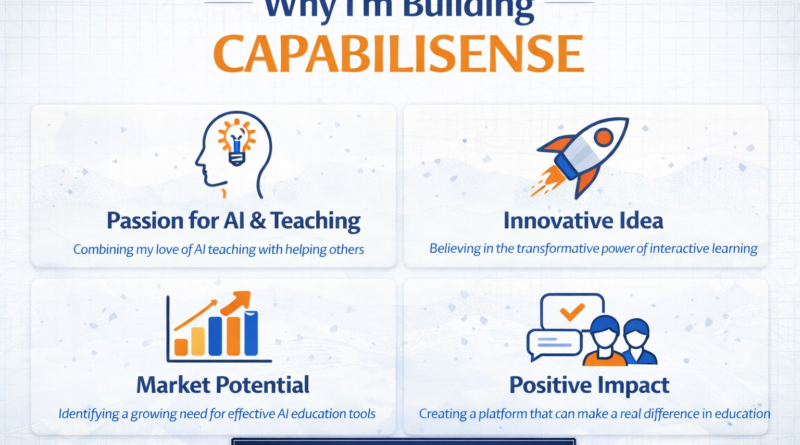
Why I’m Building CapabiliSense: Beyond the Transformation Hype
The world of corporate transformation is littered with the ghosts of expensive failures. If you have spent any time in the upper echelons of enterprise tech or organizational consulting, you know the statistics: roughly 70% to 95% of large-scale digital, AI, or cloud transformations fail to meet their original objectives. For decades, the industry has blamed “legacy tech,” “budget overruns,” or “unrealistic timelines.” But after thirty years in the trenches—from building software teams to leading global transformations at AWS—I realized the culprit isn’t the code. It is the human factor.
This realization is the heartbeat behind why I’m building CapabiliSense. We don’t need more project management tools; we need a way to sense the underlying reality of organizational capability before the first line of code is ever written.
The Problem: The “Visibility Gap” in Enterprise Change
Most organizations operate on a diet of assumptions. A CEO decides the company needs to be “AI-First.” The board approves a multi-million dollar budget. The consultants arrive with 400-page slide decks. Yet, six months later, the project is stalled. Why? Because no one actually knew if the middle management had the decision-making autonomy to execute, or if the internal “culture of excellence” was actually a culture of “permission-seeking.”
Traditional assessments are broken. They rely on subjective surveys (where employees say what they think leadership wants to hear) or static maturity models that are outdated the moment they are printed. This is the core reason why I’m building CapabiliSense. I wanted to create an “apolitical dashboard”—a way to look beneath the surface noise and identify the friction points, hidden resistances, and missing information that lead to what I call the “Cloud Vision Crash.”
Moving From “Doing” to “Sensing”
The name CapabiliSense isn’t just a brand; it’s a philosophy. It combines the concepts of capability—the collective ability to produce an outcome—with sense-making. In a world that is moving faster than our ability to document it, we cannot rely on checklists alone.
When I explain why I’m building CapabiliSense to partners, I often use the analogy of a GPS. Most transformation strategies are like a paper map; they show you where you want to go, but they don’t tell you if the bridge is out or if there is a massive traffic jam five miles ahead. CapabiliSense acts as the real-time sensor. It uses AI to analyze documented reality—processes, governance structures, and communication flows—to reveal whether an organization is actually ready for the change it claims to want.
The Three Pillars of the Framework
To solve the transformation paradox, we had to rethink what “capability” actually means. It isn’t just a list of skills on a LinkedIn profile. It is a living system. CapabiliSense is built on three fundamental truths:
- Capabilities are Contextual: A leader who excels in a stable, legacy environment might drown in a high-velocity startup. You cannot measure potential without measuring the environment it lives in.
- Systems Shape Behavior: You can train individuals all day long, but if the organizational structure rewards caution over innovation, those new skills will wither.
- Growth Requires Sensing: Transformation isn’t a “set it and forget it” event. It is a constant loop of reflection and adjustment.
By focusing on these pillars, we provide a clearer, more practical way to understand readiness. This is essentially why I’m building CapabiliSense—to turn raw potential into purposeful progress by aligning what an organization says it does with what it actually demonstrates.
Breaking the Cycle of “Patching Panic”
We’ve all seen it: a project starts to fail, and the immediate reaction is “Patching Panic.” We throw more money at it, hire more contractors, or buy another software license. But you can’t fix a systemic alignment issue with a technical patch.
My “aha” moment didn’t come from a single event; it came from seeing the same patterns of failure repeat across industries—from Airbus and AstraZeneca to European Union agencies. The disconnect between strategy and execution was always there, hidden in the “grey zones” of human interaction. This is why I’m building CapabiliSense. I wanted to move the conversation from “opinion” to “evidence.” Instead of asking a department head if they are ready for AI, we look at the data-backed starting points: Do they have the governance? Do they have the information flow? Do they have the psychological safety to fail and iterate?
A Platform Built for Transformation Agents
While the platform is powered by sophisticated AI (our Venus AI engine), its purpose is deeply human. We are building this for the “Transformation Agents”—the consulting partners, the internal change leaders, and the CISOs who are tired of being the “bad guys” who block projects at the eleventh hour.
The goal is to provide these leaders with a way to export actionable insights. Imagine being able to show a client a maturity score that isn’t based on a gut feeling, but on a rigorous analysis of their own internal documentation. That level of transparency changes the dynamic from a confrontation to a collaboration. This level of clarity is exactly why I’m building CapabiliSense.
The Future: Intentional Growth
As we look toward 2026 and beyond, the complexity of the global market is only going to increase. We are entering an era where “adaptive capability” is the only true competitive advantage. You cannot buy adaptability; you have to build it.
I am not building a tool to replace human judgment; I am building one to empower it. By removing the “grind work” of initial assessments and surfacing the “red flags” early, we allow leaders to focus on what they do best: leading people through change.
Ultimately, why I’m building CapabiliSense comes down to respect for reality. Organizations don’t need louder promises or more complex frameworks. They need a mirror. They need to see who they are, what they can actually do, and what is truly standing in their way. CapabiliSense is that mirror.
Read also our recently blog: Alhambra Palace Night Tour Attendance Revenue